About Me

My photo
Washington, United States
My love of birds began when I was a child watching the birds at my grandma's bird feeder. Ever since a black-capped chickadee perched on my hand and plucked out a sunflower seed, I have been a birder. My enthusiasm for photography quickly followed. I hope you enjoy my blogs and they inspire you to follow your own passions!

Friday, September 14, 2012

Birding in the Methow Valley and Sun Mountain, Washington


Methow River, just south of Winthrop, WA.  Photo by Kelly Wohlwend
Birding Tip #4:  Always carry your binoculars and field guide...you never know when you will need them!

Even if you may think you won't need them, I would suggest bringing them.  For example, I went camping for two days in Eastern Washington on the Methow River.  Wanting to pack lightly I decided to leave my binoculars and field guide at home.  Little did I know the Methow River and surrounding areas are excellent birding habitat.

In this post I will share some of my birding stories from this trip (including an encounter with a great horned owl!) and list the species I was able to identify at three separate locations: near my campsite along the Methow River, Beaver Pond by Sun Mountain Lodge and Patterson Lake.

Bird Counts

(Note: these are not all the birds I saw.  This is a list of the birds I was able to identify without my binoculars or field guide.  I did, however, have a good camera with me with a zoom lens, so I was able to take photos of most of the birds and identify them at home.  Remember your binoculars!).

Key: A Visual ID means I saw the bird and visually identified it.  Audio ID means I heard the bird and identified the bird based on its vocalization.  An asterisk (*) means that I have never seen this bird in nature and it is a first time sighting!

Methow River, ~2 miles south of Winthrop
Lewis's woodpecker, photo by Kelly Wohlwend (author)
  • Belted kingfisher (Audio and Visual ID)
  • Steller's jay (Audio and Visual ID)
  • American robin (Audio and Visual ID)
  • Tree swallow (Visual ID)
  • Brewer's blackbird (Visual ID)
  • Osprey (Audio ID)
  • Common merganser (Visual ID)
  • Cedar waxwing (Visual ID)
  • Lewis's woodpecker* (Visual ID)  
  • Cassin's finch (Visual ID)
  • Evening grosbeak (Visual ID)
  • Northern flicker (Visual and Audio ID)
  • American crow (Visual ID)
  • Unknown warbler (Visual ID) (Based on the size of the bird and its colors (mostly yellow/green) it was either an orange-crowned warbler - Taiga version, female yellow warbler, or Wilson's warbler.)
  • Black-capped chickadee (Audio ID)  (Note: there may also have been chestnut backed chickadees.  I didn't have any Visual ID's and both species sound very similar).
Lewis
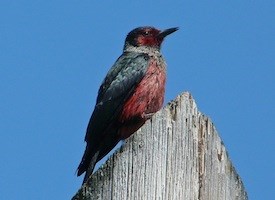
Lewis's woodpecker, photo by Mike Wisnicki
Lewis's woodpecker:

It is somewhat difficult to tell in the upper photo that I saw a Lewis's woodpecker.  However, after observing the bird's feeding and perching behavior I knew it was a woodpecker.  I watched these birds perch on a snag over the river and periodically fly out over the water, perform a few acrobatics and then fly back to the tree, sometimes perching vertically on the side of the trunk...just like a woodpecker.  This feeding behavior is typical of Lewis's woodpeckers that generally do not search for insects by boring holes in trees but by snatching them out of the air (The Cornell Lab of Ornithology, 2011).  Another feature that gave it away is the well-defined notch in the tail.  In my photo I was also able to narrow down the species by its red face, gray collar and long beak.

The Methow River was a birding hotspot!  I couldn't believe the number of birds I saw just along the river bank.  The area of the river I camped at only had a ~10 foot buffer with trees and shrubs between the campground and the river.  This buffer was equally small on the opposite side of the river, which was lined with farms.  It also seemed as if the birds were using the river as a corridor.  I watched common mergansers and other ducks travel up and downstream, staying within the river's buffer.  Other birds, such as the belted kingfisher, also traveled up and down the river, diving for fish.  There was a massive amount of insects, which most likely accounted for the high number of insectivorous birds in the area.  

Our next stop...Beaver Pond Trail near Sun Mountain Lodge
Great horned owl, photo by Kelly Wohlwend (author)
  • Great horned owl* (Visual ID)
  • Merlin falcon (Visual and Audio ID)
  • Spotted towhee (Visual ID)
  • Black-capped chickadee (Visual and Audio ID)
  • Red-breasted nuthatch (Audio ID)
  • Juvenile wood duck* (Visual ID)
  • Osprey nest (no birds present, photo below)


Osprey nest, photo by Kelly Wohlwend
The Beaver Pond Trail is an easy, mostly flat trail that is ~1.5 miles round trip.  When I first started on the trail I wasn't expecting much wildlife because of it's location near the road and relatively short distance.  Oh was I wrong!  The trail began in a beautiful setting near the pond, lined in cattails and various wetland plants.  The pine forest was also stunning, with bright, red bark and a forest floor littered in pine needles and cones.  White bark of quaking aspen speckled the forest edge and their leaves sang in the breeze.  Shortly after beginning the trail, a cacophony of Douglas fir squirrels broke the silence.  At first I thought the alarms were due to our presence on the trail, however, they were most likely for the great horned owl that silently lept from its perch and soared silently through the trees.  I was elated.  I knew it was an owl because of its size and the fact it didn't even rustle a leaf on its departure.  I'm surprised I even saw it.  We followed the owl down the path, getting glimpses of it as it flew in silence from one perch to the next.  Finally, it stopped long enough for us to admire it.  A few times it even turned its head, stared at me and made eye contact.  It was a very eerie feeling and it definitely gave me goose bumps. Once I was able to get a good visual of the owl I knew it was a great horned owl because of the feathered ear tufts.  The size of the bird also eliminates other owl species with ear tufts, however, it can be confused with the similarly sized barred owl.  Barred owls do not have ear tufts and they have completely different facial markings.

Great horned owl, photo by Kelly Wohlwend (author)


Merlin falcon, Taiga subspecies, photo by Kelly Wohlwend
Another absolutely, amazing bird we saw along this trail, not too far from the owl, was a Merlin falcon.  Having spent over a year studying Merlin falcons in Bellingham, Washington, the second I saw it I knew it was a Merlin.  It was perched on a snag overhanging the water, occasionally scanning its surroundings.  I was even more thrilled when I heard the characteristic, high-pitched "ki-ki-ki-ki" vocalization of the Merlin.  I was certain that the one I was looking at wasn't vocalizing, which meant that at least two Merlins were in the area.  There are various subspecies of Merlin falcon, including Pacific, Taiga and Prairie.  This is a Taiga subspecies because of the bright, brownish-red chest and lightly colored head (not as light as the Prairie subspecies, however).  

Photo by Christopher L. Wood
Photo by Cameron Rognan
The Merlin falcon (left) is often confused with other species, including peregrine falcon (right).  The Merlin falcon is smaller (by nearly half) and has vertical barring on the chest (adult peregrine falcons have more horizontal barring).  Also, the wing tips on Merlins do not reach the tip of the tail, unlike peregrine's.  Another feature used to distinguish the two is the head.  The Merlin has a white eye stripe (not as evident in the Pacific subspecies) and black lines on the cheeks, resembling a mustache.  The peregrine has a prominent, solid mustache that is not lined and white cheeks.

Last stop...birding on Patterson Lake

Male belted kingfisher, photo by Ed Schneider
Common raven, photo by Chuq Von Rospach
  • Great blue heron
  • Belted king fisher
  • Common raven
  • Canada geese
My time on Patterson Lake was spent in a kayak so it was difficult to really do accurate birding.  Above are the species I was able to identify with only my naked eyes and by any vocalizations.  The lake is ~1.5 miles long and is a great place for kayaking.  There are also a few trails that provide hiking along the lake and also great vantage points. What I did enjoy about kayaking Patterson Lake was how quiet the area was.  Having the lake almost entirely to ourselves, made us feel as if we were further from civilization than we actually were.  It also made the loud, croaking call of the common raven reverberate off the hills, leaving us with a chilling feeling as we floated over the still water.

My exciting birding journey in the Methow Valley was made even more memorable as I was serenaded to sleep by the "hoot hoot" of the great horned owl's song on my last night in Eastern Washington.

Thank you for following me on my journey around the Methow River Valley.  I hope my adventures encourage you to explore these amazing habitats.  Remember, don't forget your binoculars or field guide!

References:

Sibley, Allen D.  2003.  The Sibley Field Guide to Birds of Western North America.  New York: Alfred A. Knopf.  471 pp.  

The Cornell Lab of Ornithology, 2011, http://www.allaboutbirds.org

Friday, September 7, 2012

Identifying Birds in the Field: The Basics

ID that bird! exercise below.

Birding Tip #3: Get to know your birding field guide(s).  By studying your guide, you'll be able to recognize birds easier and find them faster in your guide while in the field.  You'll be surprised when you can identify a bird in the field that you haven't seen before in person but you've seen it in your guide!

The Sibley Field Guide to Birds by David Sibley is a very concise field guide and it's easy to use.  One of my favorite features of this guide is the variety of images for each species.  Since birds can trick you by changing plumage from winter to spring and the variance between males and females, it's handy to have a guide that shows you the difference.  The images are very thorough and they show you important field marks that make it easier to identify individual species.  We will look at field markers in a moment. 
 
In this guide, each family of birds has a summary page that introduces the family with some background information, separates the family into genera, provides an image of each species and gives the page number.  This page makes it easier to navigate the different families (left).

Once you get to the species you're interested in, the guide tells you some background about that species, such as whether the species is common or not, where it can be found, a physical description and the typical vocalization (right).  You will also have a range map for that species showing it's range during winter, summer, where it occurs year-round, during migration and where it is rarely seen.  In this example, you can see the variety of images of the dark-eyed junco, the Oregon and pink-sided varieties. 

I like this guide because it shows you almost every variation of that species.  It shows male and female, juvenile and any other commonly seen variations, such as the pale adult, seen below.  In the photo below you will see the dark head of the dark-eyed junco, Oregon variety.  This feature is a field mark.

photo by Ted Schroeder
So, what's a field mark?   A field mark is a visually distinct feature that distinguishes a certain species or even a family. To the right is a slate-colored variety of the dark-eyed junco.  This picture also shows another very distinctive field mark used to identify dark-eyed juncos.  Can you see it?  The white tail bars on each side of the tail occur in all junco varieties and are very apparent while in flight.


When birding, there are a few, very basic questions that should run through your head the second you see a bird.
  1. How big is it relative to other birds?  For example, is it bigger or small than a robin?  If it's smaller it may be a sparrow or a finch.  If it's about the same size it may be a thrush or grosbeak.  If it's bigger than it may be a jay or a crow.  This may seem arbitrary, but it's a very simple process of elimination that you can do rather quickly.
  2. Where am I?  This may seem like a silly question, but it's important to know where you are.  Are you on the beach or deep in an old growth forest?  This will make a big difference in the birds you're going to see.  For example, you know if you're standing in a forest far from the ocean you're unlikely to be searching the waterfowl section.  On a broader scale, you should compare where you are on a national scale (or within a state) to the range map for the particular bird (once you have identified it).  
  3. Are there any field marks?  Does the bird have a definitive feature that allows you to quickly narrow down the search?  The most common field maks are going to be color pattern.  Let's consider two relatively common species, the golden-crowned sparrow and the white-crowned sparrow. 
Golden-crowned sparrow, photo by Jeffrey Rich
White-crowned sparrow, photo by Linda Williams
 Apart from size (the golden-crowned sparrow is slightly larger) these two birds look relatively similar.  So can you identify the field mark used to distinguish these two species?  (Hint: the names give it away!).   The golden-crowned has a yellow fore-crown (the rest is white) and the white-crowned has a completely white crown.  Can you see any other differences in these two species?  Another noticeable feature is also on the head.  The white-crowned sparrow has a white eye stripe while the golden-crowned has a black cap.  I also think the golden-crowned sparrow looks tired, because it looks like it has bags under it's eyes.

Now that we have learned the basics on identifying birds, let's do an exercise.  Feel free to grab a field guide!

Below is a photo I took of a bird in my backyard.  Let's try to identify it using the questions we discussed.

Photo by Kelly Wohlwend (Author)
Ask yourself question #1, how big is this bird?  I'll help you out here, this bird is smaller than a robin.  

What about question #2, where am I?  Here's another clue, I live in a forested suburb in Western Washington at the base of the Cascade Mountain Range foothills near sea level.  

Lastly, question #3, are there any field marks?  Look for distinctive features that stand out.  How about that long tail that seems to stand upright?  It may be hard to see in this picture but do you see a white eye stripe above the eye?  Also take note of the color, what color is the bird's body and chest?  

If you have looked through a birding field guide enough you may know that this bird is a wren.  How did I know?  Wrens have a very telltale feature that makes them stand out, their tail.  Wrens generally keep their tails upright.  Some wrens, such as the pacific wren have short tails but they all stand up straight, sometimes at a 90 degree angle to the body. 

Marsh wren, photo by Marie Read
So now that you know this bird is a wren, have you figured out which one?  If you have pulled out your field guide (or are just a more experienced birder!) you will see that more than one wren has a long, cocked tail and a white eyebrow.  That is why the area you are birding in is important.  You may mistake this bird for a marsh wren, however, marsh wrens are found where their name implies, in wetland habitats (right). 

The mystery bird may also be confused with the house wren, however, the house wren has a less distinctive eyebrow and prominent, black stripes on the wing feathers.

So given all this, what bird did I photograph in my backyard?


(Answer below...no peeking!)


The answer is...a bewick's wren!

I hope you had fun and learned some helpful tools that will help you Be Your Best Birder! 


References:


Sibley, Allen D.  2003.  The Sibley Field Guide to Birds of Western North America.  New York: Alfred A. Knopf.  471 pp.  

The Cornell Lab of Ornithology, 2011, http://www.allaboutbirds.org

*book images taken from  Sibley, Allen D.  2003.  The Sibley Field Guide to Birds of Western North America.  New York: Alfred A. Knopf.  471 pp.


Sunday, August 5, 2012

Mount Rainier National Park Birding Special!

Birding Tip #2: Explore New Habitats!  By venturing into new areas you will notice a change in the bird species you see.  You may also see subspecies of familiar birds that have large ranges and adapt to various niches, such as the dark-eyed junco.


Bird Count:
  • Sooty grouse (Audio ID)
  • American robin (Visual ID)
  • Red-breasted nuthatch (Audio ID)
  • Chestnut-backed chickadee (Visual ID) (black-capped were most likely present as well, but were not visibly seen) (Audio ID of chickadees).
  • Olive-sided flycatcher (Audio ID)
  • Common raven (Audio ID)
  • Hairy woodpecker (Audio and Visual ID)
  • Steller's jay (Audio and Visual ID)
  • Gray jay (Visual ID)
  • Clark's nutcracker (Audio and Visual ID)  
  • Northern flicker (Audio ID)
  • Dark-eyed junco (Audio and Visual ID) (note: it is possible that I was seeing female dark-eyed juncos but most of the juncos I saw did not have a bold black head as seen in the Oregon variety.  These juncos resembled more of the slate-colored variety, however, this variety is mostly seen in eastern Washington.  Unfortunately, I didn't have enough time to identify the birds properly, besides to say they were dark-eyed juncos).
  •  Varied thrush (Feather ID on trail, see below) (Photo of bird in Post #2 - "A Swift Sighting")


feather
U.S. Fish and Wildlife Service, The Feather Atlas, http://www.lab.fws.gov/fa/index.php

(author's note:  Most bird species are protected under the Migratory Bird Treaty Act (MBTA) which "makes it illegal for anyone to take, possess, import, export, transport, sell, purchase, barter...or offer for sale, any migratory bird, or the parts, nests, or eggs of such a bird except under the terms of a valid permit issued pursuant to Federal regulations" (U.S Fish & Wildlife Service, Migratory Bird Program, 2012)). 

There are essentially three "zones" in Mount Rainier National Park...all three I visited during my stay over the weekend.  The weather was spectacular, as can be seen in the first photograph taken on Sunday.  The temperatures were climbing into the high 80s, even at 5000+ feet.  It is important to note that the high temperatures may have contributed to the lack of birds I saw on my three day excursion through the park.  It may also be important to mention that I didn't go to Mount Rainier specifically for birding, otherwise I would have been up and about at prime birding times.  The best times for birding are the first few hours after sunrise when it's cool and in the evening.  My hiking had me outside during the daytime when most birds were laying low in the shade and out of the hot sun.


Silver Falls, Silver Falls Trail, photo by Kelly Wohlwend
The first zone of Mount Rainier National Park is the lowest area of the park, below 3,500 feet.  These areas are more heavily forested, with the dominate tree species being Douglas fir, western red cedar and western hemlock (National Park Service, 2012).  I visited this area of the park when I hiked the Silver Falls Trail along the Ohanapecosh River and headed up towards the Grove of the Patriarchs.  I didn't complete the entire Silver Falls Trail loop, which is nearly 3 miles, but the northern portion heading north toward the Grove had spectacular views of the waterfall and river.  The hike in this area is easily traversed and leads through beautiful forests with a vast diversity of plants.  It's well worth the hike.  This area is home to bird species more typically seen at lower elevations, such as those seen around the Puget Sound lowlands and the Cascade foothills.  This is where I identified the varied thrush feathers.  

Bench and Snow Lakes Trail, photo by Kelly Wohlwend
The second zone of the park is the transitional area between 3,500 feet and 5,000 feet, below the subalpine zone.  The dominate tree species are western hemlock, western white pine and Pacific silver fir (National Park Service, 2012).  The forest is less dense with more open meadows.  It also seemed as if plant growth was stunted because the trees didn't grow as tall, perhaps because of the elevation.  I visited this zone when I hiked the Bench and Snow Lakes Trail, east of Paradise.  The birding was best along this trail.  Despite the heat, which I'm sure is what kept most of the birds quiet along the hike, I heard the olive-sided flycatcher here and saw a variety of dark-eyed juncos.  Dark-eyed juncos are easily seen by their white tail bars while in flight.  I only saw the juncos for a few seconds and I didn't have my binoculars handy but I did notice that they all had very faint black heads and the bodies were more gray.  It is possible that some of the juncos I saw were females, which have a dull, black head.  Regardless, it is important to be aware when birding of the different subspecies and realize that females can look significantly different than males and very similar to other species of birds.  Overall, the hike is moderately strenuous, with a lot of steep up and down climbing on stairs, but the beautiful wildflowers, lakes and views make the 2.5 mile round trip hike well worth it.  


Valley of Avalanche Lilies along the Nisqually Vista Trail, photo by Kelly Wohlwend

Sooty grouse, photo by Tom Lawler
The third zone is the area accessible at Paradise and Sunrise and is between 5,000 feet and 6,500 feet in elevation.  This zone is considered the subalpine zone.  The tree species have once again changed and the forest tends to grow in clumps with dominating subalpine meadow habitat.  The tree species found here are subalpine fir, mountain hemlock, Alaska yellow cedar, and whitebark pine (National Park Service, 2012).  I hiked this area at Paradise when I went around the Nisqually Vista Loop.  This hike is very easy and is a fully paved hike with great views of Mount Rainier.  It takes you through a variety of habitats characteristic of this altitude.  You can get a perfect vantage point of the Nisqually glacier, as well.  This is also where I heard two sooty grouse males vocalizing to each other in the forest.  It is a very low pitched, best described as a whooping sound.  Unfortunately, I didn't see them, leaving the trails is prohibited and being an avid environmentalist, I was happy to follow the rules.  

The fourth zone, which comprises a majority of the park is over 6,500 feet in elevation and the landscape is mostly bare rock, snow and ice (National Park Service, 2012).

One place I haven't mentioned so far is my campsite, an unexpected place for birding.  I camped at Cougar Rock, which is at roughly 3,000 feet in elevation.  Despite the amount of people present, I still saw and heard a wide variety of species.  I heard chickadees, common raven, red-breasted nuthatch and northern flicker.  I saw a hairy woodpecker and, of course, a good number of steller's jays, which are common campsite visitors.  The hairy woodpecker, a larger version of the downy woodpecker (downy woodpecker are far more common in more disturbed forests and visits my backyard feeder on a regular basis), not only made an appearance but vocalized a song and call.  I was very excited to hear the hairy woodpecker song and call in person because seeing the bird and then hearing its vocalizations is the best way to learn when birding by ear...but that is another post!  Hairy woodpecker are rather uncommon and tend to stay in more mature, undisturbed forests.  I have seen one hairy woodpecker near my house, although I live near the foothills of the Cascade Mountains so it was probably a lost juvenile.

Clark
Clark's nutcracker, photo by Scott A. Haber
Another place I visited at Mount Rainier National Park was a quick pit stop on the way home...Tipsoo Lake.  It is located on the eastern border of the park along Highway 410.  I only stopped for a quick bite and to enjoy one last moment on the mountain but Tipsoo Lake is a tourist hotspot, so it was very busy.  While I sat and enjoyed a sandwich in the shade I noticed a few bird species hanging out around the picnic tables.  One was a clark's nutcracker.  I have seen these birds before in the pine forests of Grand Teton National Park.  These birds are netorious for raiding picnic areas, like the steller's jay, and in areas heavily used by humans they are becoming more and more of a menace.  More importantly, people are humanizing a bird species that naturally eat mostly pine seeds.  Clark's nutcracker are found at high elevations and inhabit forests dominated by pine trees, because of their dietary needs (The Cornell Lab of Ornithology, 2011).


Gray Jay Photo
Gray jay, photo by Gerrit Vyn
A second species of bird that I saw in the same area while munching on my lunch was a gray jay.  This was the first time I had ever seen a gray jay and without my bird book in hand, I wasn't sure what bird I was looking at.  After doing some research I wasn't surprised they were hanging out with the clark's nutcracker and sneaking yummy, human snacks when the opportunity arose.  Gray jays inhabit a similar niche as the clark's nutcracker; high altitude, alpine forests.  There are three subspecies of gray jay; Pacific, Taiga and Rocky Mountain varieties.  The Pacific and Taiga look incredibly similar and the gray jays I saw at Tipsoo had a prominent black head, so it could have been either of the two.  The Rocky Mountain subspecies has a mostly white head.  I watched gray jays and clark's nutcrackers move in groups together as they perused the buffets left by people, some people were even (to my utter dismay) feeding the birds right out of their hands!  Gray jay have been dubbed the "camp robber" (The Cornell Lab of Ornithology, 2011).  The name seemed to fit but I wonder if humans are partially to blame. 


Please DO NOT feed wildlife!  It is detrimental to their health and yours...for more information please read the National Park Services information page on this issue at http://www.nps.gov/mora/planyourvisit/keep-wildlife-wild.htm.


Keep Wildlife Wild logo
Image from the National Park Service


Thank you for following me on my birding journey through Mount Rainier National Park and Happy Birding!

References:


National Park Service, 2012, http://www.nps.gov/mora/naturescience/birds.htm 

Sibley, Allen D.  2003.  The Sibley Field Guide to Birds of Western North America.  New York: Alfred A. Knopf.  471 pp.  

The Cornell Lab of Ornithology, 2011, http://www.allaboutbirds.org

U.S Fish & Wildlife Service, Migratory Bird Program, 2012, http://www.fws.gov/migratorybirds/mbpermits.html

Saturday, July 28, 2012

The Ospreys Have Returned!


 Birding Tip #1: Look Up!  It's a simple tip but it really works.

I figured today would be just another walk with my dogs...although I usually have my eyes and ears open for birds.  I had only just begun when I saw an osprey silently gliding along the water's edge close by, occasionally obscured by the trees.  I kept my eyes on him or her (telling the difference between male and female ospreys is rather difficult) as much as possible without missing my footing and going sprawling headfirst onto the sidewalk.  After a few minutes, I lost sight of him.  Then, the familiar high pitched chirping sound of the osprey made me turn my head.  I saw him perched at the top of a tall Douglas fir tree in a backyard.  He (or she) presumed to chirp incessantly.  I stopped and watched, my dogs constantly tugging on the leash eager to continue their walk.  I'm sure people were wondering what I was looking at...or perhaps not, considering people passed by me and no one bothered to look in the direction I was focused on, despite the bird's racket.
Juvenile
Photo by Kim Taylor, Virginia, July 2011


From my experience observing Merlin Falcons, raptors generally vocalize while perched at the top of tall trees for a number of reasons.  The calling may have been to a mate or a juvenile calling for its parents, or vice versa.  Unfortunately, without binoculars and notoriously bad vision I had a hard time distinguishing whether it was a juvenile or not based off of the pronounced white outline on the black feathers on the back of the bird's body.  (Also, given the time of the year, the young may not have fledged yet, aka learned to fly).  I'm pretty certain I was looking at an adult.  Other reasons a raptor may be vocalizing in this manner is to signal that it has food for the nesting parent.  It could have also been territorial, however, ospreys are usually only territorial in the near vicinity of their nests (The Cornell Lab of Ornithology, 2011) and the nest was not in sight. 
 
Juvenile at nest
Photo by Kim Taylor, Virginia, July 2011


This isn't the first time I've seen ospreys near where I live.  They have been returning each summer for years.  Last year, after finishing up a walk, I saw one soar in my direction, flying very low, with something in its talons.  I stood on the sidewalk and watched it perch at the top of a cedar in the neighbor's backyard and rip apart a fish.  It looked up often to make sure another bird wasn't going to steal its lunch.

Osprey are almost exclusively fish eaters, whether it's fresh or saltwater fish.  They're really good at fishing, with success rates reaching as high as 70% (studies examined by The Cornell Lab of Ornithology, 2011).  They also create interesting nests...mostly because of their location.  Ospreys generally nest on the top of flat surfaces, such as dead standing trees (snags), cliffs, telephone poles and man-made nesting platforms (The Cornell Lab of Ornithology, 2011).  With all that fish it must get rather smelly...fortunately most osprey nests have good ventilation!

Photo by Kelly Wohlwend (author)
Driving out of Jackson, Wyoming (it's been many, many years since, so I want to say I was heading west) after visiting Grand Teton National Park, I saw one osprey nest after another along the road.  Unfortunately, this was before I purchased my Nikon with a zoom lens...but hopefully you can see the osprey in the nest.  These nests were all built on man-made platforms, specifically made for ospreys to construct their nests.

Allaboutbirds.org (one of my favorite birding websites) has a live web cam set up in Montana of a nesting osprey.  Take a look!
http://www.allaboutbirds.org/page.aspx?pid=2487

Another interesting factoid that I (sadly) was unaware of was the fact that the Seattle Seahawks' name and logo were inspired by the osprey.  Another name for the osprey is, you guessed it, sea hawk.  I guess the resemblance is pretty obvious. 
Image from wallpaperstub.com
Photo: An osprey preparing to dive
Photo courtesy of NASA from nationalgeographic.com

So, just remember, birds are everywhere and you never know what bird you'll see that day...so look up and Happy Birding!

References:


The Cornell Lab of Ornithology, 2011, www.allaboutbirds.org

Sibley, Allen D.  2003.  The Sibley Field Guide to Birds of Western North America.  New York: Alfred A. Knopf.  471 pp.  

Wednesday, July 4, 2012

A Swift Sighting

Adult male with young
Pileated woodpecker photo by Aida Villaronga
The Pacific Northwest has been the only place in the continental United States not baking in an oven.  We've been "enjoying" cool temperatures and quite a bit of rain until today...the 4th of July.  I wonder what the birds think of all the fireworks that go off during the day and especially at night.  Most are probably perched in the relative safety of a tree hoping it doesn't get blown to smithereens from a stray firework.  Only if birds had cognitive, human thoughts...I guess. 

Today the weather is turning around.  Dubbed the first day of summer in Seattle, the 4th of July has been comfortably warm with a slight breeze.  After getting home from work (yes I unfortunately had to work today) I decided to soak up some rays (not too upset I missed the sun bath because the rest of the week is supposed to hit the mid-80s).  I've seen a number of strange birds from my backyard, or maybe not strange but birds I wouldn't expect to see in the suburbs, from pileated woodpeckers to varied thrushes and even western tanagers.
Varied thrush, photo by Kelly Wohlwend

Western Tanager Photo
Western tanager  photo by Stephen Parsons


Male in flight
Barn swallow, Photo by JMK Birder

But the one I saw flying over my house today was one of the most exciting...black swifts.  A very uncommon bird (not even described by the Cornell Lab of Ornithology, 2011), I had to do a double-take as I saw it erratically flying in the clear, blue sky today.  At first I knew it wasn't a swallow because of it's size.  Swallows have an average wing span of 12 inches and I could tell even from my land-locked place on Earth that this bird was bigger and much darker.  Black swifts are also recognizable by their tail, which is larger and more pronounced when they fly, unlike most swallows.  A majority of swallow species have a forked tail (watch out, not all of them, check the cliff swallow!), which is very distinguishable. 


Black swift, photo from the Slater Museum of Natural History

As I sat on my deck, soaking up the evening rays I watched these amazing birds dance in the sky, intertwined with the smaller, white (on the belly) tree swallows.  I could easy separate the tree swallows from the swifts by their bright, white underside and smaller, pointed tail.  Trying to get the swifts in my binoculars was the biggest challenge...but once I had one on my radar I was able to confirm my sighting.  Just another bird to check off my life list...


References:

The Cornell Lab of Ornithology, 2011, www.allaboutbirds.org

Sibley, Allen D.  2003.  The Sibley Field Guide to Birds of Western North America.  New York: Alfred A. Knopf.  471 pp.