About Me

My photo
Washington, United States
My love of birds began when I was a child watching the birds at my grandma's bird feeder. Ever since a black-capped chickadee perched on my hand and plucked out a sunflower seed, I have been a birder. My enthusiasm for photography quickly followed. I hope you enjoy my blogs and they inspire you to follow your own passions!

Sunday, June 23, 2013

Birds of the Sierras - Part 1: Upland Meadows


Hint #11:  Incorporate drawing and journaling in with your
Sample from my nature journal
birding!  It's a great way to allow you to explore other media than photography and you'll notice greater details and interesting behaviors by close observation.  You'll be surprised what you find when you start sketching!


I just got back from a fantastic six day camping trip in the Sierras along Highway 49.  I was taking a
nature journaling course and birding at the same time.  In this post I'll show you some of the different habitats I visited, what birds I found there and birding hotspots around Hwy 49.  I'll also share some of my bird sketches to hopefully inspire you to record what you see in a new, exciting way :)

I was shocked at how many different bird species I saw in the Sierras.  So here it is, the list of all species seen and or heard in the Sierras.  (?) = a questionable sighting.  I am fairly confident on my ID but not enough to be certain.  (*) = a species I have never seen before (a life species for me).  I did not put (*) next to questionable sightings for my life list.  (v) = the species was identified by vocalization only.

Grand Total Sierra Bird Count
((Total species: 61 (does not include questionable sightings).  Total new personal life species: 19))   Alphabetized by common name

American avocet (v)                         Olive-sided flycatcher (v)
American bittern*                            Osprey
American coot                                   Pied-billed grebe
American robin                                 Pileated woodpecker (v)
Mountain Chickadee, photo by author
Anna's hummingbird                        Pine sisken
Bald eagle                                            Purple finch
Barn swallow                                    Pygmy nuthatch
Black-headed grosbeak (v)               Red-breasted nuthatch (v)
Brewer's blackbird                            Red-winged blackbird
Brown creeper                                  Red-tailed hawk
Calliope hummingbird*                    Rufous or allen's hummingbird (female) (?)
Cassin's finch*                                  Sandhill crane*
Chipping sparrow (v)                       Sage thrasher*
Clark's nutcracker*                           Savannah sparrow*
Cliff swallow*                                  Steller's jay
Common raven                                 Tennessee warbler (?)
Dark-eyed junco                               Turkey vulture
Downy woodpecker (v)                    Warbling vireo* (v)
Evening grosbeak                             Western tanager
Forster's tern*                                   Western wood-pewee*
Fox sparrow - thick-billed                White-faced ibis*
Gadwall                                             White-headed woodpecker*
Great blue heron                                Willow flycatcher*
Green-tailed towhee*                        Wilson's warbler
Golden-crowned kinglet (v)              Wood duck
Hermit thrush (v)                              Yellow-headed blackbird*
Hermit warbler*                                Yellow-rumped warbler
Lincoln's sparrow (?)                         Yellow warbler (v)
MacGillavry's warbler                       Common merganser (forgot to add)
Mallard
Marsh wren
Mountain bluebird
Mountain chickadee*
Nashville warbler (v)*
Northern harrier


 Alpine Meadows and Wetlands - Elevation ~6,000ft.

Yuba Pass
A striking meadow of wildflowers next to the Yuba Pass campground is our first birding hotspot!  This place is home to a lot of small, mid-canopy and shrub dwelling birds such as mountain chickadees, red-breasted nuthatch, yellow warbler and a variety of sparrows. 

However, one bird in particular nests here and observing it was an experience I won't soon forget!  In a short, stump in the trees on the edge of the meadow lives a white-headed woodpecker.  It was a life bird for me (meaning I've never seen or heard it before) and I couldn't look away.  During this sighting I didn't journal, too enthralled by the bird and wanting to get a good picture or two.  (I was with a fellow birder on this excursion).  We first noticed the female woodpecker, clinging to a tree, motionless (below middle).  She looks identical to the male (below right) except she lacks the red patch on the back of her head.  Next we saw the male with a gourmet snack.  He scoped the area, prepared for landing and then went into the nest to a mouthful of hungry young.
Female white-headed woodpecker


After a few comings and goings by both parents, the male decided he wanted to take a rest and where would be the best place for a quick (or in this case long) breather?  Well, with his head plugging up the nest hole of course!   You can just barely see the red patch on his head (left).  The male white-headed woodpecker literally chilled out in this position, only moving his head ever so often for about 10 minutes.  I wanted to get a great in flight shot, so I waited and waited and waited for him to depart the nest.  Cramped and stiff I waited.  When he left it was quick and way to fast for me to even press the button on my camera.  I had to laugh at his sense of humor. 

White-headed woodpeckers are somewhat common in this part of the Sierras and prefer to be in areas near open meadows or water.  Some woodpeckers in the Sierras prefer burned tree stands, such as the black-backed woodpecker, a woodpecker we searched for and didn't find, except for a potential fleeting glimpse in flight and some drumming (not enough to make a definitive ID).


Sand Pond Interpretative Trail 

 Basics:  6,000ft in elevation, 0.8 mile loop, mostly flat with some boardwalk and tons of mosquitoes!  Don't forget your repelent! 

Sand Pond, Photo by Kelly Wohlwend (author)
This was a great trail for birding.  It begins at the clear, warm Sand Pond, which is just downstream of Lower and Upper Sardine Lakes along Sardine Lake Road.  From Hwy 49 near Bassetts turn onto Gold Lake Hwy, onto Packer Lake Road, and then onto Sardine Lake Road. 
Willow Flycatcher Photo
Willow flycatcher, photo by Kelly Azar
Before we talk about Sand Pond, I want to throw in a snippet about the willow flycatcher (which I heard and saw briefly but couldn't photograph).  There is a willow thicket and wetland off of Packer Lake Road with great birds, including the elusive and hard to find willow flycatcher (right).  It is rather rare locally and is considered an indicator species because it is relatively sensitive to habitat change. 
Western wood-pewee, photo by author

Now for Sand Pond.  I spent half my time swatting at mosquitoes but the trail is great and easy to walk.  Along the way I saw orange-crowned warblers, western wood-peewee (another flycatcher).  Notice on both flycatchers the thin bill, straight body generally perched upright or at a slight angle and the tell tale crest of feathers on the head.  Most flycatchers are rather drab looking with rather prominent wing bars.  Another bird I saw and had an amazing close interaction with was the wilson's warbler.

Wilson's warbler, photo by Kelly Wohlwend

Wilson's warblers are cute, little yellow warblers with a black cap.  They have an olive colored back, wings and tail.  Like all warblers their main food of choice is insects.  They prefer habitats near water and frequent willow thickets.  Wilson's warblers also have a large vocal vocabulary and their signature song generally changes between individuals and locations.


Let's travel up Sardine Creek to Lower and Upper Sardine Lakes.

http://upload.wikimedia.org/wikipedia/commons/1/14/Green-tailed_Towhee.jpg
Green-tailed towhee, photo from wikimedia.org
Upper Sardine Lake, photo by Kelly Wohlwend
This is a relatively short trail but steep.  It's also covered in large cobbles so wear hiking shoes!  The views are incredible and the birding is decent.  This is where you can see and hear the green-tailed towhee!  I have also read that this trail is frequented by off road vehicles (however, I didn't see any when I took the trail).  The relative seclusion offered by Upper Sardine Lake makes the trek worth it. 

Lower Sardine Lake from the beginning of the trail, photos by Kelly W
Hiking the trail to Upper Sardine Lake (Lower Sardine on Left)

When I hiked this trail the sun was overhead and the weather was heating up fast.  Generally birds take shelter at this point but a few were out, mostly the towhees.  I had a great moment with a green-tailed towhee when it perched in a pine tree only feet behind me.  I was so mesmerized by it in my binoculars I didn't stop to take a picture.

Another bird I saw along the trail was an osprey hunting over Lower Sardine Lake.  It was awesome to watch such a large bird of prey hunt over open water from a vantage point that allowed a full, unobstructed view.


That's it for this part of "Birds of the Sierras."  Stay tuned for Part 2 where we explore the stunning Sierra Valley where I saw the most new species, saw the most amazing birds and got the best photos!


Thursday, March 14, 2013

How To Identify Gulls...A Conundrum

Hint #10:  Don't get discouraged when birdingTake it from me, I know it can be frustrating when you can't figure out what species of bird you're looking at.  Birding is meant to be fun, enjoyable and exciting, so when you can't figure out the species in that moment, take notes on its color, shape, size, etc and look it up later.

In this post I'm going to identify five common gull species found in San Francisco, California and teach you how to identify them.  I'll also provide tips on what to look for when you are first learning how to identify gull species.  We'll also try to solve a mystery gull species at the end of this post!

Hundreds of gulls (mostly mew gulls) at Crissy Field.  Photo by Kelly Wohlwend (author)

Gulls are incredibly misunderstood birds, in my opinion.  They have a reputation for being lunch snatchers, poop machines, landfill guests and an overall pest.  But in natural settings where people haven't altered their behavior, gulls actually shy away from people and don't accept hand-outs (which is the way it should be)They are also smart, having learned to get their food out of tough to reach spaces.  I'll tell a story about this in a bit.  I would recommend referring back to my previous post called "Identifying Birds in the Field: The Basics."  This will help with your overall skills in bird identification and is handy to read before continuing on in this post.  It will teach you about field marks, identifiable features on a bird and the basics of bird identification.
 
Gull external anatomy from ibird.com
Anyway, back to the gulls.  The term "seagull(s)" is a generic term applied to all gull species.  The proper way to refer to a gull is merely "gull(s)" or by its species name.  When identifying gulls, there are a few key places on its body you want to look first.  These are the beak, legs and wingsIf you can see them clearly, the eye color and presence or absence of an eye ring are also great features to note.

The reason these body parts are so important when identifying gulls is knowing their shape, color and markings will quickly narrow down the field when you're trying to pinpoint the gull species you're identifying.  

So let's look at our first gull.  Easily one of the most common gull species on the west coast, a frequent picnic crasher and scavenger is the western gull.  In a natural setting, these gulls eat fish and shellfish.  One fantastic adaptation these birds have (like some other gulls, including glaucous-winged gulls) is breaking open shellfish.  On the shores of the San Jaun Islands in Washington state, I have seen these gulls dig clams up on the beach, fly up high, hover in the air for a moment and then drop their clam.  Gravity cracks open the clam on the rocky beach and the gull gets to enjoy a salty, slimy treat.  

Western gull, photo by Kelly Wohlwend (author)
These gulls are easily identified by the key body parts we listed above.  The first thing you want to look at are the feet.  In western gulls they are pink.  Knowing this eliminates half of the gull species found in western North America.  Next, the beak.  It's very large and yellow (minus the red dot on the bottom part of the beak).  The absence of black on the bill further narrows down the candidates.  Thirdly, the wingsThe wings include the gray on the back and the black and white feathers near the tail.  These black and white feathers are called primary feathers and the color of these and the dark gray on the wings is another good indicator of a western gull.  Lastly, the eyes.  This can be tricky but what you're looking at is the eye color.  The iris of the western gull is yellow or considered "pale" in field guides.  A few other things you may notice about this bird is the large, blocky white head and white chest.  The bird overall is rather large, as well, 25 inches long.

California gull, photo by Kelly Wohlwend (author)
The next gull we're going to look at is very similar, which is why I want to do it next.  Take a moment and consider some differences and similarities that you notice before I reveal the species.  

This is a California gull.  A beautiful gull, in my opinion, and very similar to the western gull above.  Let's look at those key body parts.  The feet are yellow!  That feature is the most obvious difference and will allow you to eliminate this as a western gull straight away.  The California gull has a smaller beak and it has different colors than the western gull, it has black markings near the tip and a red mark on the lower half, like the western gull.  The wing color is nearly the same, gray, with black and white primary feathers.   The eyes are different, however, noticeably even.  The California gull has a dark, nearly black iris.  A few more features about this species are the size and head color.  This gull is a bit smaller than the western gull and has a smaller, rounder head.  In breeding season (when this photo was taken) the California gull has an entirely white head, while in nonbreeding season it is streaked brown.

I hope you're doing okay still and encouraged to learn about three more gull species and solve a mystery species at the end!

Ring-billed gull, photo by Kelly Wohlwend (author)
This gull is a bit tricky to identify in the photo.  This is a ring-billed gull.  I hope the reason it was named this is obvious when you look at the photo.  This gull is rather small, nearly 4 inches shorter than the California gull.  It has a small beak with a distinct black ring and NO red.  The legs are yellow (not visible in the water).  When you can't see the legs, the ring on the bill alone would allow you to identify this species.  The wings are a lighter gray than the California gull and the primary feathers (wing tips) are black (not really visible)The white spots on the wing are smaller than the California or western gull's.  The eyes are pale in color with a red eye ring.  This photo was taken in nonbreeding season, which is why the head has light, brown streaking.  In breeding season it is entirely white.  

Mew gull, photo by Kelly Wohlwend (author)
Our next gull is small, cute and quint and one of my favorites.  It is the mew gull.  It is smaller yet than the ring-billed gull by a little over an inch and has a tiny, yellow beak with a faint ring around it (visible in the photo).  The legs are yellow and the wings are a slightly darker gray than the ring-billed gull with black and white primary feathers (wing tips).  The white spots on the wings are a bit bigger than the ring-billed.  The iris of the eyes are clearly dark with no visible eye ring, similar to the California gull.  The head is small and round and in nonbreeding season (when this photo was taken) is covered in a gray streaking.  In breeding season it is white.  I really like the small size of this gull and it is generally rather shy and lights to congregate in huge flocks, as seen in the picture of Crissy Field above.  

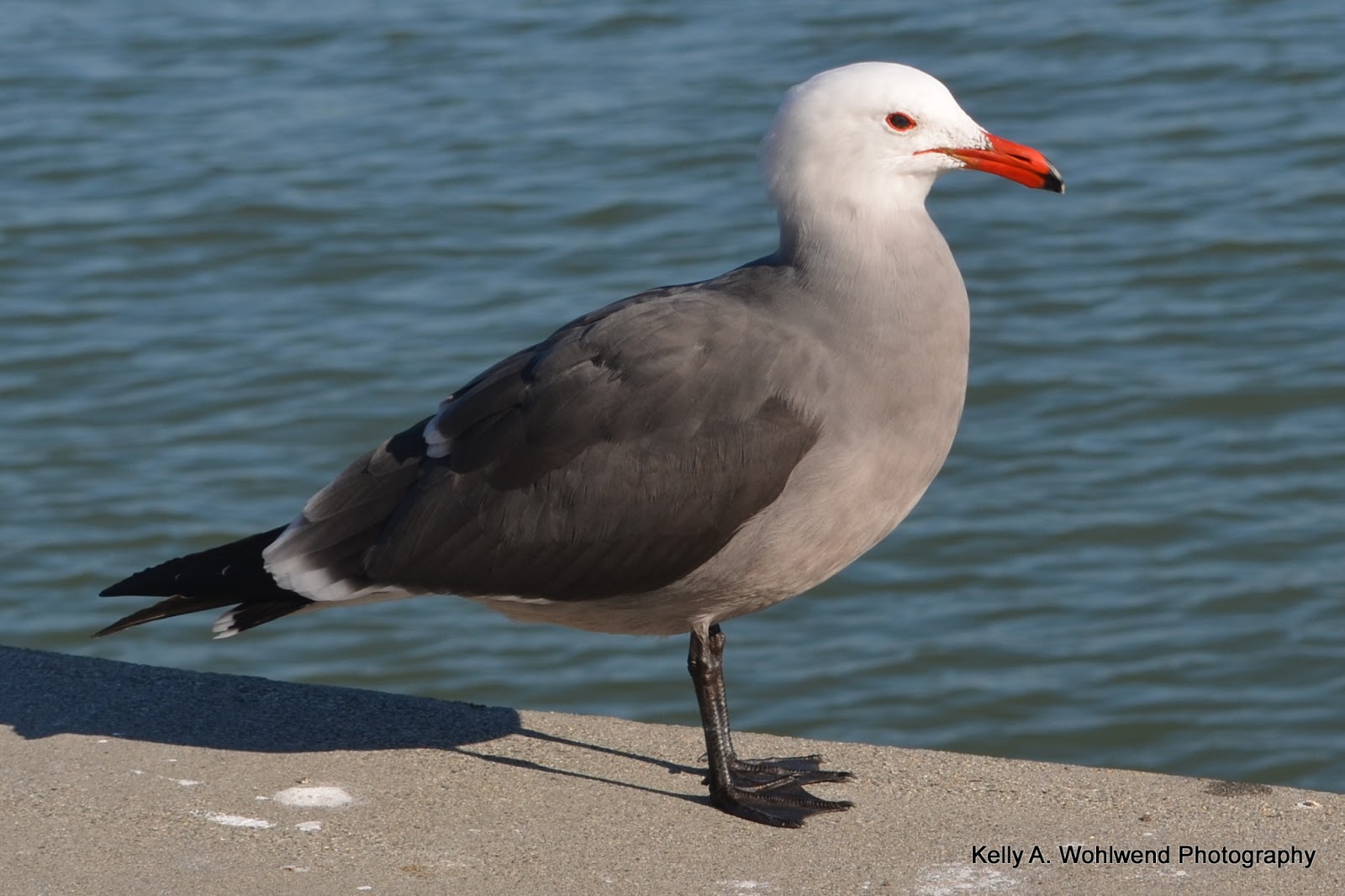
Adult Heermann's gull, photo by Kelly Wohlwend (author)
Juvenile Heermann's, photo by Kelly W.

Our next gull looks completely different than the ones we have just identified.  When I first saw it as a juvenile I had no clue what it was.  For a moment I thought it was a jaeger (type of gull species) but it is a rather common gull, perched on roof tops at Fisherman's Wharf, watching for a french fry or piece of deep-fried fish to fall from someone's plate.   It didn't help that the juvenile (left) looks completely different than the adult (right).  I thought they were different species!  Having never encountered this gull back in Washington state (since their range doesn't extend much north of the bay area) I had to take photos and check my field guide later.  This is a Heermann's gull.  A striking gull with a blood red, beak tipped in black and jet, black legs (which are also seen in jaegers, hence my initial confusion)The iris of eyes is also dark and in this photo it appears to have a red eye ring, however, this isn't too obvious in my field guide.  The wings are dark gray with nearly all black wing tips.  The white spots in the wing primaries (apparent in the nonbreeding season) disappear and leave them completely black for breeding season.  The adult was photographed in this species breeding season so it has an entirely white head.  The gray prevalent on the rest of the body would spread and cover the head in nonbreeding season.  This gull is also relatively small compared to the western gull we looked at first, measuring 6 inches smaller.  

It's time to use our new gull identification skills to figure out our mystery gull! 
Our mystery gull, photo by Kelly Wohlwend (author)

This gull, to this day, makes me second guess myself.  It was absolutely monstrous looking in person.  Let's start at the beginning.  The beak is large and very thick and yellow with a red spot on the bottom.  The legs are clearly pink.  Okay...starting to look like our first gull, a western gull.  The wings are dark gray and the wing tips are black with obvious white spots.  Hmm...still resembling a western gull.  The eyes are a bit off...they appear dark in the photo and when I saw this bird in person (mind you it was only about 10 feet away) the eyes were not obviously pale like in the photo of the western gull aboveIt could just be the evening lighting shading the eye.  Now the head and neck coloring.  There is more gray streaking on this bird than is normally seen in western gulls sporting their nonbreeding season plumage.  It is generally far more subtle and less prominent on the face.  The outstretched, long neck is also strange.  I realize a bird can merely stretch it's neck but it just seemed unusually long and the head doesn't seem as blocky as a western gull's.  Going back to the size of the bird.  It was huge.  It made me go, woah, that's a big bird!  It didn't appear to look like your average western gull.  So what gull species is this?  Honestly, I'm not 100% sure

Gulls are tricky.  They hybridize, which means, different species interbreed where their ranges overlap, making gull identification even more difficult.  This could be a glaucous-winged gull x western gull hybrid, which may explain the heavier streaking on the head and perhaps larger body size.  The wings are a big too dark, however.  But it's possible.  It is most likely a western gull that threw me off.   

This is a perfect example as to why gull identification can be frustrating but an exciting challenge, nonetheless.  Remember don't get discouraged, have fun, enjoy yourself and remember to...

Keep Your Eyes On The Sky!     
 

Wednesday, February 6, 2013

Bolinas Lagoon Birding Special!

American avocets in flight, photo by Kelly Wohlwend
Birding Tip #9:  Revisit Your Favorite Birding Spots!  You might see something new!   

Hint:  If you are a beginning birder, the best place to start practicing is an open water body that isn't too large, like a lake or lagoon.  The best types of birds to learn if you're a beginner are waterfowl because they are generally large, have distinguishable features and generally don't move around too much.  They also aren't obstructed by bushes and trees, generally.

Author's note:  All of the photos in this post were taken by the author (Kelly Wohlwend) at Bolinas Lagoon on February 2nd, 2013.  The species counts were also done on this day.  For more of my photos from Bolinas Lagoon please visit my other blog, Kelly A. Wohlwend Photography.  The link is at the top of this blog.  Thank you and enjoy!


I recently returned to Bolinas Lagoon along Highway 1 just south of Point Reyes National Seashore. Not only is the area stunning, the amount of birds is mind blowing! I was shocked the first time I saw the mudflats and open water literally swarming in small (sometimes large) feathered bodies, but seeing it again was just as awe inspiring. 

Bolinas Lagoon is an absolutely fantastic, can't miss birding location for a number of reasons.  The eastern side of the lagoon is protected forestland, providing excellent habitat, the lagoon is large, which gives birds plenty of space to spread out and stay away from people (this is good for those shy species!) and the ecology of the lagoon changes with the tides!  During part of the day the tide is in and populated by ducks and grebes and the rest of the time the mudflats are exposed, which is perfect habitat for shorebirds, such as sandpipers and plovers.

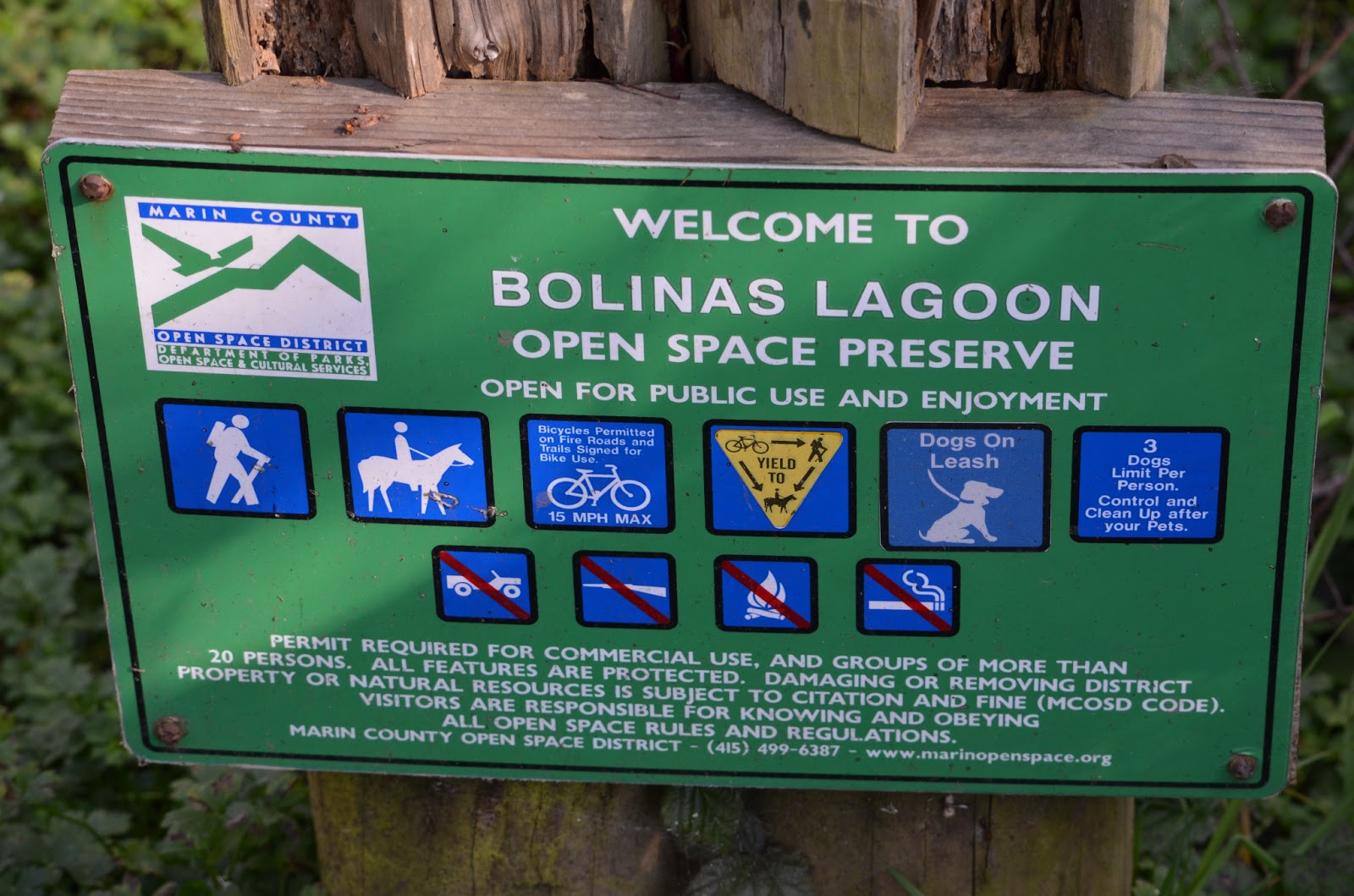
I also discovered another rich birding spot here at Bolinas, the Bolinas Lagoon Open Space Preserve (trail head sign seen above).  It is a small, forested thicket with a few winding, dirt trails that lead you out onto the marshy expanse of the lagoon.  I wasn't expected to see as many birds as I did.  Before I talk about the birds I saw at the preserve I am going to talk about my experience birding along the eastern shore of Bolinas Lagoon.

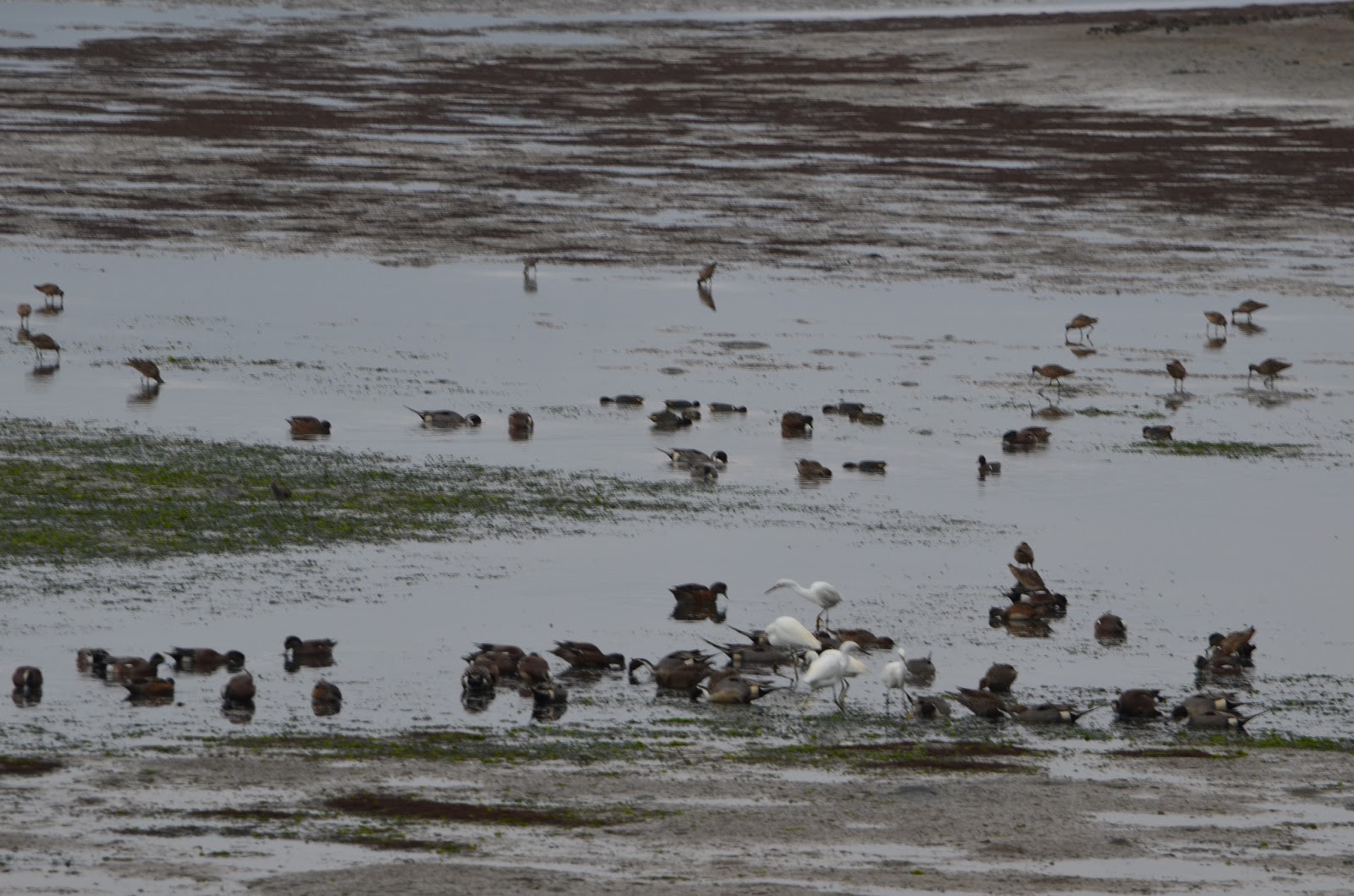
Bolinas Lagoon, eastern shore, photo by Kelly Wohlwend
When you first approach the lagoon, it doesn't seem too big, but as soon as you turn a corner it opens up in front of you like the ocean.  When the tide is high it's spectacular!  One thing I can't show in pictures is what it sounded like, thousands and thousands of birds chirping, squawking, cawing, croaking, screeching and countless other vocalizations I can't even describe.   The photo to the right does not do the image of the lagoon and its birds justice.  There were just too many to capture with one camera shot, this is merely a fragment of the lagoon.  Time for the species count!
Birds at the lagoon


Bolinas Lagoon Species Count
(* represents a first time sighting!)
Northern pintails, Bolinas Lagoon, photo by Kelly Wohlwend
  • American Wigeon
  • American Avocet
  • American Kestrel (just north of the lagoon)
  • Belted Kingfisher
  • Bufflehead
  • Common Goldeneye
  • Great Egret
  • Greater Scaup
  • Greater Yellow-legs
  • Green-winged Teal
  • Horned Grebe
  • Long-billed Curlew
  • Mallard
  • Marbled Godwit*
  • Mew Gull
  • Northern Pintail
  • Red-tailed Hawk
  • Ruddy Duck
  • Snowy Egret
  • Surf Scoter
  • Turkey Vulture
  • Western Gull
  • Willet
  • Unknown sandpiper species
American wigeons, Bolinas Lagoon, photo by Kelly Wohlwend

The bird species I saw in the most abundance, by far, were American wigeons. The males are characterized by their white facial stripe, green and speckled gray/brown heads, white bill with a black tip, rufous colored bodies and white and black rumps.  The females are more drab with the same rufous colored bodies and a speckled gray head lacking the green and white facial stripe seen on the male.  (In the photo to the right, focusing on the two wigeons on the right, the one to the far right is a female, the one immediately to her left is a male). 

Eurasion wigeons are an uncommon species that look similar to the American wigeon but the Eurasion's head is a brighter rufous color and lacks the green.  In the females, the color of the head blends in with the body.  Eurasion wigeons also have a flatter shaped head.  So far, I have yet to see one.  Another duck species which I have seen before and absolutely love are green-winged teals. 


They are relatively shy and are difficult to approach, so I was fortunate to get such good photos.  The green-winged teals I saw at Bolinas Lagoon were foraging in the shallow water on the mudflats.  I'm particularly fond of them for their striking colors but also for their size.  They're slightly larger than a bufflehead.

The male (left) is very beautiful, with a steel gray body, black and tan rump and a green and dark auburn colored head.  On the side of the body the white stripe is significant when distinguishing between the green-winged teal and the Eurasian subspecies.  The Eurasian subspecies looks nearly identical but lacks this white bar.  The female green-winged teal is rather drab but the green wing feather is very noticeable on her body (right). 

One thing I will say about Bolinas Lagoon is even though it is huge and the birds are numerous and packed together, generally multiple species, it is a great place for relatively new birders.  I would have a good pair of binoculars and your field guide, for sure (a camera with a zoom lens won't hurt either or a scope would be even better) but waterfowl are relatively easy to identify because they sit relatively still for long periods of time.  When identifying birds in thick understory and the birds are small (this can be tricky with sparrows because they all look relatively similar) birding can get frustrating.  I like to recommend people begin birding on waterfowl. 

Now the journey takes us to Bolinas Open Space Preserve on the west side of the lagoon.

If you want to visit the preserve there are a few things to note.  There is side street parking next to the trail head, which is marked with the sign pictured above.  There is only room for about six cars, so it can be hard to park on a weekend.  The trail can also get a bit muddy in spots so be prepared!

When I first walked into the preserve and I saw the blanket of nonnative species and thicket of relatively bare trees, I wasn't expecting much bird wise.  I was happily mistaken.  So here's the list!

BolinasLagoon Open Space Preserve Species Count

("audio" next to the species means I identified the bird by its vocalization)
Bolinas Open Space Preserve once the trail leaves the trees with Bolinas Lagoon in the distance, photo by Kelly Wohlwend
  • American Robin (audio)
  • Anna's Hummingbird
  • Bewick's Wren (audio)
  • Black Phoebe
  • Bushtit
  • Common Raven
  • Fox Sparrow
  • Great Egret
  • Hairy Woodpecker
  • Hutton's Vireo
  • Osprey
  • Pacific Wren
  • Pine Siskin (audio)
  • Red-shoulderd Hawk (audio)
  • Ruby-crowned Kinglet
  • Scrub Jay
  • Song Sparrow
  • Spotted Towhee (audio)
  • Marsh Wren?
  • Peregrine Falcon?
You may be wondering why I have question marks next to two of the species?  Well, I'm 99% sure they're what I saw but the wren darted into the bushes so quickly (twice) I couldn't get it in my binoculars.  Given the cocked tail, color of the body, size of the bird and the habitat, my guess is a marsh wren.  Unfortunately it never vocalized.  The peregrine falcon is also almost a certainty.  It was a fly over and even though I briefly got it in my binoculars it was masked by the thick tangle of tree branches.  But the wing shape, wing beat pattern, size shape and color of the bird all indicate a peregrine falcon.


Osprey perched at the preserve
Osprey diving over the lagoon
The views from the preserve are a reason to go even if there were no birds.  It's spectacular, especially on a clear day.  I was treated to a wide variety of birds, a few I'm going to talk about now.  I did see an osprey perched in the middle of the marshy field on a post (left).  He was incredibly far away, so I didn't get a decent photo.  It was exciting to later see him diving in the lagoon (right).  The birds didn't seem spooked by his hunting, most likely because he's a fish eater. 

A bird I did see and want to talk about in detail is the hutton's vireo.  They are a cute, small greenish-yellow bird that greatly resembles a ruby-crowned kinglet, which were also preening the twigs for bugs at the preserve.  At first I thought it was a kinglet, but the size made me think twice, immediately.  The hutton's vireo and the ruby-crowned kinglet are in completely different families, the hutton's is in the family Vireonidae and the kinglet, Regulidae.

Some of the main differences:
The first and most noticeable is the hutton's vireo lacks black wing bars below the second white stripe on the wings.  In the picture below of the vireo, notice the two white stripes on the wings?  There is some black present between the stripes but on the ruby-crowned kinglet there is a dark black stripe below the lower white stripe.  This is the easiest way to tell these two species apart.

The second and third main differences are the size and eye markings.  The hutton's vireo is a full inch longer than the kinglet and has a larger wingspan by two inches.  The vireo also has more prominent eye markings.  Notice in the photo below the large, white eye ring.  The white also continues to the beak (slightly less noticeable in this photo) and the beak is larger in the hutton's, as well.  In the ruby-crowned kinglet, the eye ring is less prominent and the kinglet lacks the white patch that continues to the beak. 

The fourth main difference is the vocalizations.  The ruby-crowned kinglet sings a soft, sweet, high pitched ascending song.  The hutton's vireo sings a varying series of warblers and high pitched notes.  I would recommend visiting The Cornell Lab of Ornithology's All About Birds website and listen to these songs.  This is a great website for listening to bird songs and exploring life histories of birds.
Hutton's vireo, Bolinas Lagoon Open Space Preserve, photo by Kelly Wohlwend
Snowy egrets and a great egret, Bolinas Lagoon, photo by Kelly Wohlwend
Before I conclude my journey at Bolinas Lagoon I wanted to share one more photo that I took at my last stop before leaving.  A group of snowy egrets all stood in a line with a great egret standing sentry in the back.  As I got as close as I could without leaving the pullout, one by one the snowy egrets took to wing and flew a short distance to other bank.  The great egret watched his subordinates with great care.  It definitely put a smile on my face.


Thank you for coming on this journey with me to the beautiful and breathtaking Bolinas Lagoon!